Saturday, January 21, 2012

The Robots of CES  - Technology Review

back3/9next
-->

The Xybot turns an ordinary iPhone into a mobile avatar. A phone docked into the robot streams video of the person controlling it using an app running on another iPhone.

Xybotyx of Littleton, Colorado, which makes the robot, was founded by two engineers who met while working on NASA’s Phoenix Mars rover. The Xybot will be released in March at a price of $111.11.

Helluva lot cheaper than a presence bot. Another example of the ubiquity of the SmartPhone making computing / networking / etc effectively free.

Posted via email from _technoist_

Cartels Are an Emergent Phenomenon, Say Complexity Theorists - Technology Review

in a population of a million agents over time period of a billion iterations and more.

The results make interesting reading.  It turns out that a crucial factor is the speed at which buyers and sellers react to the market. When buyers react quickest, sellers are forced to match the best possible value for money and prices tend to drop.

By contrast, when sellers react quickest, they are quick to copy others offering poor value for money. This reduces the number of sellers offering good value for money in a vicious cycle that drives prices as high as possible. 

This is the emergence of a cartel and it happens in these guys' model without any collusion between sellers. Instead, it is an emergent property of the market place that happens when the sellers outperform buyers in the way they react to market conditions. 

Cool result from computational economics. I wonder if similar things occur throughout the dynamics of new product adoption.

Posted via email from _technoist_

Friday, November 11, 2011

Good insights into the future of Computer Interaction and todays blithe assumptions

take out your favorite Magical And Revolutionary Technology Device. Use it for a bit.
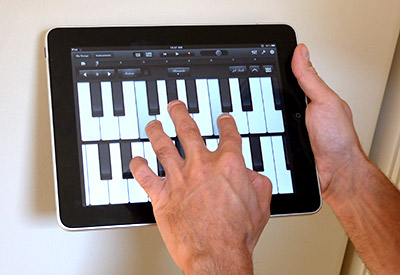
What did you feel? Did it feel glassy? Did it have no connection whatsoever with the task you were performing?

I call this technology Pictures Under Glass. Pictures Under Glass sacrifice all the tactile richness of working with our hands, offering instead a hokey visual facade.

Is that so bad, to dump the tactile for the visual? Try this: close your eyes and tie your shoelaces. No problem at all, right? Now, how well do you think you could tie your shoes if your arm was asleep? Or even if your fingers were numb? When working with our hands, touch does the driving, and vision helps out from the back seat.

Pictures Under Glass is an interaction paradigm of permanent numbness. It's a Novocaine drip to the wrist. It denies our hands what they do best. And yet, it's the star player in every Vision Of The Future.
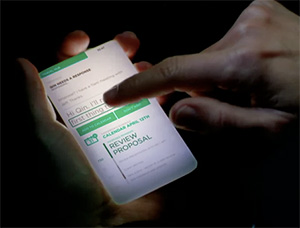
To me, claiming that Pictures Under Glass is the future of interaction is like claiming that black-and-white is the future of photography. It's obviously a transitional technology. And the sooner we transition, the better.

HANDS MANIPULATE THINGS

Excellent points on limitations of our current magical devices. Highly recommend that you read the original rant from Bret Victor. http://worrydream.com/ABriefRantOnTheFutureOfInteractionDesign/

The reality is that there is no more embodied approach for devices extant as yet, with possible exceptions of robotics homebrew/arduino/etc. However these certainly don't have anything like the levels of 'magic' interaction that we're enjoying today with the 'pictures under glass'.

I'm not holding my breath for new approaches any time soon, but longer term ...

Posted via email from _technoist_

Sunday, September 11, 2011

Cool company - BuildAR - building blocks to make Augmented Reality creation easy ...

What will you build?

Augmented Reality (AR) overlays information, images, 3D objects, audio and video onto your view of the real world around you.

Create your own mobile AR projects easily with no development required & link your content to the real world!

Steps to technology ubiquity - virtualizing the underlying complexity ... Looking forward to seeing more from these guys.

Posted via email from _technoist_

The books business: Great digital expectations | The Economist

TO SEE how profoundly the book business is changing, watch the shelves. Next month IKEA will introduce a new, deeper version of its ubiquitous “BILLY” bookcase. The flat-pack furniture giant is already promoting glass doors for its bookshelves. The firm reckons customers will increasingly use them for ornaments, tchotchkes and the odd coffee-table tome—anything, that is, except books that are actually read.

In the first five months of this year sales of consumer e-books in America overtook those from adult hardback books. Just a year earlier hardbacks had been worth more than three times as much as e-books, according to the Association of American Publishers. Amazon now sells more copies of e-books than paper books. The drift to digits will speed up as bookshops close. Borders, once a retail behemoth, is liquidating all of its American stores.

Ongoing sad times for the local bookstore.

Isn't this part of a larger trend, building 'cloud' / or ubiquitous connectivity and information into all of our lives. The same trend impacting IT across the board. Bringing both disruption of our comfortable ways of doing things, and radical new capabilities?

Posted via email from _technoist_

Game Theory

It is possible that Richard Thaler changed his mind about economic theory and went on to challenge what had become a hopelessly dry and out-of-touch discipline because, one day, when a few of his supposedly rational colleagues were over at his house, he noticed that they were unable to stop themselves from gorging on some cashew nuts he'd put out. Then again, it could have been because a friend admitted to Thaler that, although he mowed his own lawn to save $10, he would never agree to cut the lawn next door in return for the same $10 or even more. But the moment that sticks in Thaler's mind occurred back in the 1970's, when he and another friend, a computer maven named Jeff Lasky, decided to skip a basketball game in Rochester because of a swirling snowstorm.

Posted via email from _technoist_

A deep diver into the anatomy of premature scaling - lessons for startups and others

Scaling operations (optimizing for a given product/customer assumption) before confirming that it's _real_ is a bad idea - Startup Genome shows some good data on this for startups, and probably a bad idea for others with new product hopes.

Posted via email from _technoist_